
increase charity auction revenue

Charity Event Scams Exposed: How Fake Ticket Sellers Target High-Demand Fundraising Events

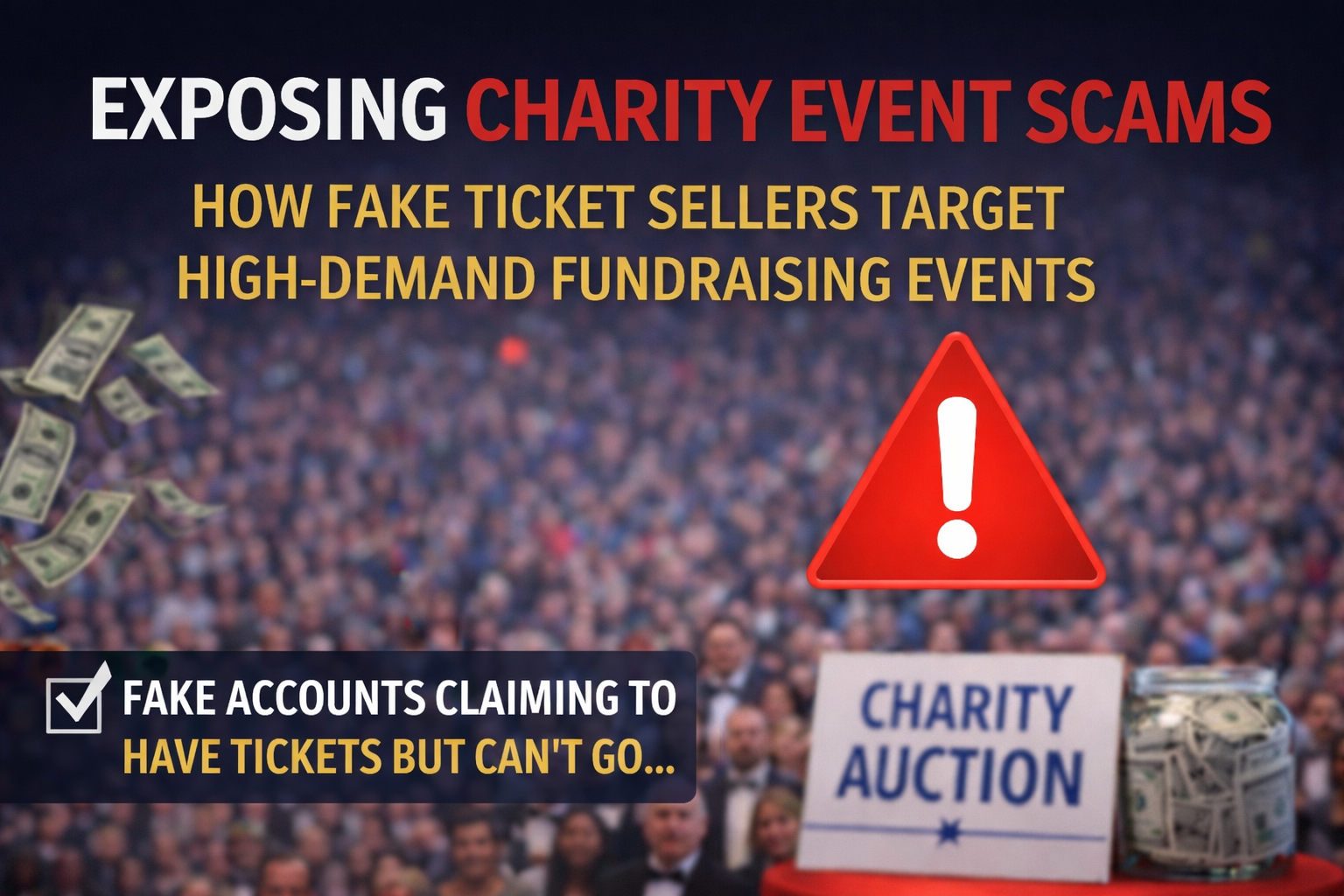
Warning graphic highlighting fake ticket sellers targeting sold-out charity auctions and fundraising events on Facebook, educating nonprofits about ticket scams and event security.

As you know, we here at BW Unlimited Charity Fundraising are always looking out for our clients and charities across the country — we are your watchdogs.

That means staying ahead of problems before they impact your event, your donors, or your reputation.

Right now, one of the biggest issues we’re seeing across Facebook and social media is a surge in fake ticket scams targeting charity events, fundraising galas, and live auctions.

So we’re going to break it down for you — how it happens, why it happens, and how to shut it down immediately.


Why Charity Fundraising Events Attract Scammers

When a charity gala sells out or a fundraising event gains momentum, it sends a very clear signal:

👉 High demand
👉 Strong community support
👉 A must-attend experience

And that’s exactly what scammers are looking for.

Using automated tools, fake accounts scan platforms like Facebook for keywords such as:

  • charity auction tickets

  • sold out fundraising event

  • charity gala near me

  • live auction tickets

  • political fundraiser tickets

  • nonprofit fundraising events

The second your event starts trending… they show up.


How Fake Ticket Scams Work at Charity Auctions and Fundraising Events

Here’s exactly how it plays out:

  1. Your charity event is announced or sells out

  2. Engagement increases on your social media posts

  3. Fake accounts immediately comment:
    “I have tickets but can’t go, message me”

  4. They move the conversation to private messages

  5. They collect payment — and disappear

These scams are designed to exploit urgency and excitement — especially when your event is in high demand.


Why Hiring a Professional Charity Fundraiser Protects Your Event

This is where working with an experienced, professional team matters.

When you partner with a professional charity fundraiser and fundraising company like BW Unlimited, you get:

  • Full control of ticketing and guest management

  • Proven fundraising strategies that drive sell-outs

  • Secure and structured event operations

  • High-end auction item sourcing

  • Risk-free consignment auction items

  • Exclusive luxury charity travel packages

  • Protection against fraud, misinformation, and online scams

We don’t just run auctions — we protect the integrity of your entire event.


How to Protect Your Charity Event from Ticket Scammers

If you’re planning a nonprofit fundraising event, gala, or charity auction, here’s what you should be doing:

✔ Clearly state: “No third-party ticket sales”

✔ Monitor and delete suspicious comments immediately

✔ Pin a scam warning on all event posts

✔ Work with a trusted charity fundraising company

The more proactive you are, the less opportunity scammers have.


Why High Demand Charity Events Sell Out

At BW Unlimited, our events consistently:

  • Sell out

  • Generate record-breaking fundraising revenue

  • Attract major sponsors

  • Create unforgettable donor experiences

Because we combine:

  • Expert charity auctioneering

  • Strategic fundraising event planning

  • High-value auction inventory

  • Exclusive charity travel packages

  • Nationwide nonprofit support

When done correctly, demand becomes inevitable.


High-Value Auction Items That Drive Attendance and Revenue

A major driver of successful fundraising events is access to premium auction items, including:

  • Luxury charity travel packages

  • Private villa experiences

  • VIP sports and entertainment packages

  • Celebrity memorabilia

  • One-of-a-kind donor experiences

Through CharityTravelPackages.org, we provide risk-free consignment travel packages that eliminate upfront cost and maximize bidding competition.


Final Thoughts: If Scammers Are Targeting You, You’re Doing It Right

Here’s the reality:

👉 Scammers don’t target weak events
👉 They target high-demand, sold-out experiences

If they’re showing up on your posts, it means your event has attention, momentum, and value.

Use it as confirmation — and then shut them down fast.


Ready to Sell Out Your Next Charity Event?

If your organization is looking to:

  • Increase fundraising revenue

  • Secure high-end auction items

  • Offer luxury travel experiences

  • Work with a nationally recognized charity auctioneer

We’re ready to help you dominate your next event.

👉 Visit BWUnlimited.com
👉 Explore CharityTravelPackages.org
👉 Learn more at GeorgeWooden.com
The Most Common Charity Auction Mistakes That Hurt Fundraising Results

There is a well-known saying that perfectly describes what happens in many charity fundraising auctions:

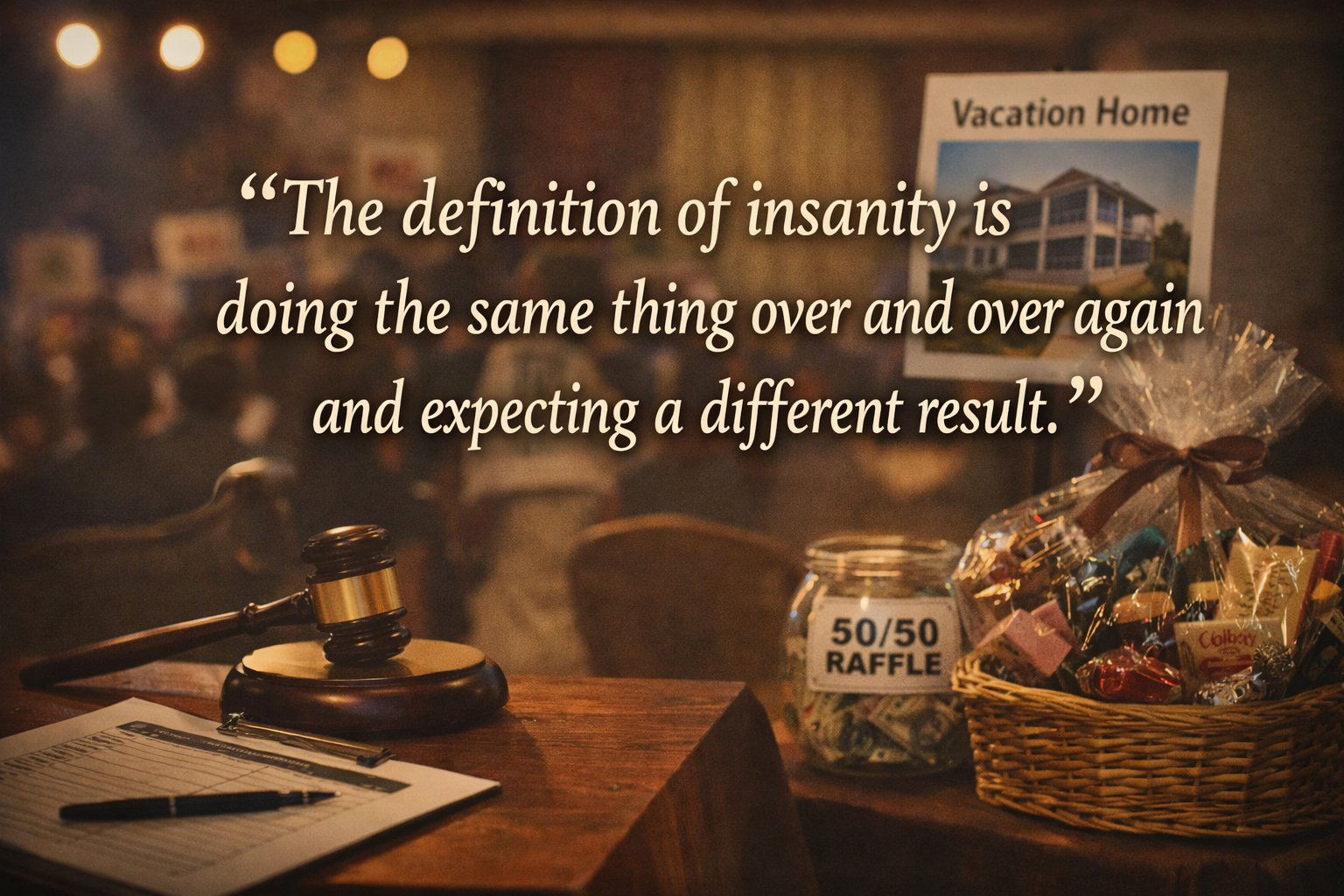
“The definition of insanity is doing the same thing over and over again and expecting a different result.”

Yet year after year, nonprofits repeat the same charity auction items, the same silent auction inventory, and the same fundraising auction strategy. When results stay flat or decline, many organizations are surprised. When fundraising goals are missed, they often look for someone to blame.

Too often, that blame lands on the auctioneer.

In reality, most underperforming charity auctions fail because of auction item strategy, inventory selection, donor psychology, and outdated fundraising myths.


Repeating the Same Charity Auction Items Produces the Same Results

One of the most common nonprofit fundraising mistakes is recycling the same auction items year after year.

I recently attended a meeting with a nonprofit reviewing their fundraising auction. Once again, they offered the same vacation home they have used for years. They also repeated experience items such as “Dinner with the Boss.”

Same auction items.
Same audience.
Same expectations.

Donors remember what they have seen before. They already know whether they want the item, what it is worth to them, or whether they passed on it previously. Once an auction item becomes predictable, competitive bidding disappears.

No benefit auctioneer can force excitement for stale inventory. Auctioneers amplify demand, but they do not create it.

If your charity auction catalog looks the same every year, your fundraising results will too.


When Fundraising Results Decline, Charities Shoot the Messenger

Instead of analyzing auction strategy, many organizations replace the auctioneer when fundraising auctions underperform.

Changing the auctioneer feels decisive, but it avoids the harder work of examining the real problem.

If the charity auction items are recycled, predictable, or uninspiring, changing who holds the microphone will not fix the issue. The problem is not execution. The problem is inventory and strategy.

Before replacing an auctioneer, nonprofits should evaluate:

  • Whether their silent auction items still excite donors

  • Whether live auction experiences feel fresh

  • Whether inventory reflects what donors actually want


The Gift Basket Myth in Silent Auctions

Gift baskets remain one of the most common silent auction items, yet they are also one of the lowest-performing charity auction items.

I often ask nonprofit boards a simple question:

How many gift baskets did you give to your family or friends for Christmas?

The answer is almost always none.

That response says everything. People do not actively want gift baskets. They feel generic, inconvenient, and forgettable. They are included because they are easy to assemble, not because they raise meaningful money.

If you are searching for silent auction items that sell well or high-profit auction items for fundraising, gift baskets are rarely the answer.


Too Many Silent Auction Items Reduce Fundraising Revenue

Another major nonprofit fundraising mistake is offering too many silent auction items for the size of the event.

When there are too many items relative to the number of guests:

  • Bids spread thin

  • Competition disappears

  • Items sell at minimums or not at all

A successful silent auction is curated, not crowded. Scarcity creates urgency. Fewer, higher-quality auction items almost always outperform a room full of filler.

If your goal is to increase silent auction revenue, inventory discipline matters.


Showing Retail Value Anchors Bids Downward

Many charities believe listing retail value helps justify pricing. In reality, it often suppresses bidding.

When donors see retail value, they shift into bargain-hunting mode. They look for deals instead of competing. That mindset caps bids before the auction even starts.

Charity auctions are not retail environments. Guests already expect to pay less than retail. Displaying those numbers trains donors to shop rather than give.


The 50/50 Raffle Problem in Fundraising Events

The 50/50 raffle remains one of the most puzzling fundraising traditions.

Organizations sell raffle tickets and then intentionally give away half of the money raised. There are many raffle formats that:

  • Keep 100 percent of the proceeds

  • Create excitement

  • Increase participation

Raffles should generate unrestricted fundraising revenue, not dilute it.


The Myth That Fully Donated Auction Items Are the Most Important Factor

Many nonprofits believe that fully donated auction items are the key to fundraising success, even while reusing the same donated items year after year.

Donors do not bid high because something was donated.

They bid high because they want it.

People may care about the mission with their hearts, but they spend with their wallets. Exciting auction items, premium experiences, and high perceived value drive competitive bidding.

This is why properly structured consignment auction items often outperform recycled donated items.


Why Charities Resist Consignment Auction Items but Pay for Everything Else

Charities routinely pay for:

  • Venues

  • Catering

  • Alcohol

  • Entertainment

  • Décor

  • Production

None of these expenses directly raise money.

Yet when it comes to auction items, which are the primary revenue engine of the event, many boards resist anything that is not donated. This inconsistency costs charities significant fundraising revenue.

If an organization is willing to invest in the event, it should be willing to invest in the part of the event that raises the money.

No-risk consignment auction items exist specifically to solve this problem by delivering fresh, exciting inventory without financial exposure.


Fix the Fundraising Strategy, Not the Auctioneer

When charity auctions underperform, the issue is rarely the auctioneer. It is almost always the strategy.

Common causes include:

  • Recycled auction items

  • Too many silent auction items

  • Weak or predictable experiences

  • Retail value anchoring

  • Inefficient raffle structures

  • Misunderstanding donor psychology

A professional benefit auctioneer can drive urgency, energy, and competition, but only if the inventory supports it.


What Actually Works in High-Performing Charity Auctions

Successful nonprofit fundraising auctions use a modern, intentional approach that includes:

  • Fresh charity auction items

  • Curated silent auction inventory

  • Premium travel and experience packages

  • A balanced mix of donated and consignment auction items

  • Strategic fundraising auction planning

  • An experienced charity auctioneer

When auction items create desire, donors compete. When donors compete, fundraising goals are exceeded.


Final Thought on Charity Auction Success

If a nonprofit repeats the same auction items and the same fundraising approach year after year, it should not expect different results.

Replacing the auctioneer without fixing the strategy is simply shooting the messenger.

Effective fundraising requires evolution, intentional planning, and a willingness to challenge outdated beliefs.

Doing the same thing over and over again and expecting a different result is not a strategy.

It is insanity.