charity auctioneer

The Most Common Charity Auction Mistakes That Hurt Fundraising Results

There is a well-known saying that perfectly describes what happens in many charity fundraising auctions:

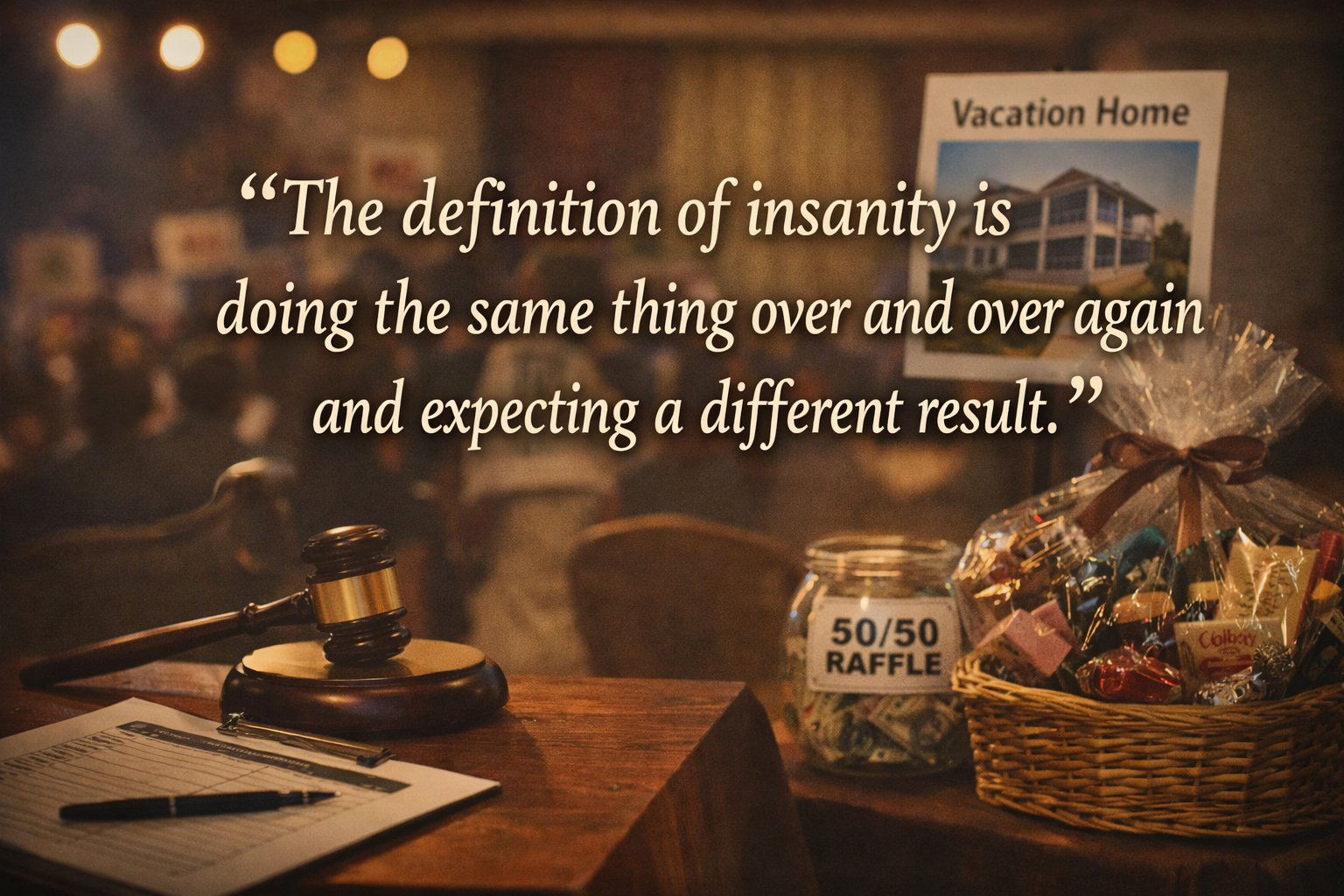
“The definition of insanity is doing the same thing over and over again and expecting a different result.”

Yet year after year, nonprofits repeat the same charity auction items, the same silent auction inventory, and the same fundraising auction strategy. When results stay flat or decline, many organizations are surprised. When fundraising goals are missed, they often look for someone to blame.

Too often, that blame lands on the auctioneer.

In reality, most underperforming charity auctions fail because of auction item strategy, inventory selection, donor psychology, and outdated fundraising myths.


Repeating the Same Charity Auction Items Produces the Same Results

One of the most common nonprofit fundraising mistakes is recycling the same auction items year after year.

I recently attended a meeting with a nonprofit reviewing their fundraising auction. Once again, they offered the same vacation home they have used for years. They also repeated experience items such as “Dinner with the Boss.”

Same auction items.
Same audience.
Same expectations.

Donors remember what they have seen before. They already know whether they want the item, what it is worth to them, or whether they passed on it previously. Once an auction item becomes predictable, competitive bidding disappears.

No benefit auctioneer can force excitement for stale inventory. Auctioneers amplify demand, but they do not create it.

If your charity auction catalog looks the same every year, your fundraising results will too.


When Fundraising Results Decline, Charities Shoot the Messenger

Instead of analyzing auction strategy, many organizations replace the auctioneer when fundraising auctions underperform.

Changing the auctioneer feels decisive, but it avoids the harder work of examining the real problem.

If the charity auction items are recycled, predictable, or uninspiring, changing who holds the microphone will not fix the issue. The problem is not execution. The problem is inventory and strategy.

Before replacing an auctioneer, nonprofits should evaluate:

  • Whether their silent auction items still excite donors

  • Whether live auction experiences feel fresh

  • Whether inventory reflects what donors actually want


The Gift Basket Myth in Silent Auctions

Gift baskets remain one of the most common silent auction items, yet they are also one of the lowest-performing charity auction items.

I often ask nonprofit boards a simple question:

How many gift baskets did you give to your family or friends for Christmas?

The answer is almost always none.

That response says everything. People do not actively want gift baskets. They feel generic, inconvenient, and forgettable. They are included because they are easy to assemble, not because they raise meaningful money.

If you are searching for silent auction items that sell well or high-profit auction items for fundraising, gift baskets are rarely the answer.


Too Many Silent Auction Items Reduce Fundraising Revenue

Another major nonprofit fundraising mistake is offering too many silent auction items for the size of the event.

When there are too many items relative to the number of guests:

  • Bids spread thin

  • Competition disappears

  • Items sell at minimums or not at all

A successful silent auction is curated, not crowded. Scarcity creates urgency. Fewer, higher-quality auction items almost always outperform a room full of filler.

If your goal is to increase silent auction revenue, inventory discipline matters.


Showing Retail Value Anchors Bids Downward

Many charities believe listing retail value helps justify pricing. In reality, it often suppresses bidding.

When donors see retail value, they shift into bargain-hunting mode. They look for deals instead of competing. That mindset caps bids before the auction even starts.

Charity auctions are not retail environments. Guests already expect to pay less than retail. Displaying those numbers trains donors to shop rather than give.


The 50/50 Raffle Problem in Fundraising Events

The 50/50 raffle remains one of the most puzzling fundraising traditions.

Organizations sell raffle tickets and then intentionally give away half of the money raised. There are many raffle formats that:

  • Keep 100 percent of the proceeds

  • Create excitement

  • Increase participation

Raffles should generate unrestricted fundraising revenue, not dilute it.


The Myth That Fully Donated Auction Items Are the Most Important Factor

Many nonprofits believe that fully donated auction items are the key to fundraising success, even while reusing the same donated items year after year.

Donors do not bid high because something was donated.

They bid high because they want it.

People may care about the mission with their hearts, but they spend with their wallets. Exciting auction items, premium experiences, and high perceived value drive competitive bidding.

This is why properly structured consignment auction items often outperform recycled donated items.


Why Charities Resist Consignment Auction Items but Pay for Everything Else

Charities routinely pay for:

  • Venues

  • Catering

  • Alcohol

  • Entertainment

  • Décor

  • Production

None of these expenses directly raise money.

Yet when it comes to auction items, which are the primary revenue engine of the event, many boards resist anything that is not donated. This inconsistency costs charities significant fundraising revenue.

If an organization is willing to invest in the event, it should be willing to invest in the part of the event that raises the money.

No-risk consignment auction items exist specifically to solve this problem by delivering fresh, exciting inventory without financial exposure.


Fix the Fundraising Strategy, Not the Auctioneer

When charity auctions underperform, the issue is rarely the auctioneer. It is almost always the strategy.

Common causes include:

  • Recycled auction items

  • Too many silent auction items

  • Weak or predictable experiences

  • Retail value anchoring

  • Inefficient raffle structures

  • Misunderstanding donor psychology

A professional benefit auctioneer can drive urgency, energy, and competition, but only if the inventory supports it.


What Actually Works in High-Performing Charity Auctions

Successful nonprofit fundraising auctions use a modern, intentional approach that includes:

  • Fresh charity auction items

  • Curated silent auction inventory

  • Premium travel and experience packages

  • A balanced mix of donated and consignment auction items

  • Strategic fundraising auction planning

  • An experienced charity auctioneer

When auction items create desire, donors compete. When donors compete, fundraising goals are exceeded.


Final Thought on Charity Auction Success

If a nonprofit repeats the same auction items and the same fundraising approach year after year, it should not expect different results.

Replacing the auctioneer without fixing the strategy is simply shooting the messenger.

Effective fundraising requires evolution, intentional planning, and a willingness to challenge outdated beliefs.

Doing the same thing over and over again and expecting a different result is not a strategy.

It is insanity.

How to Host a Fundraising Event That Stands Out (and Sells Out)

Are You a Small or Growing Charity?

Let me ask you three quick questions:

  1. Is your nonprofit organization long-established with a large, paid staff?

  2. Do your fundraising events consistently secure over $100,000 in sponsorships?

  3. Are your event tickets priced over $200, and do you sell out every year?

If you answered “No” to all three, here’s what you’ve just admitted (even if it stings):

You’re likely a small or grassroots charity.

You may be volunteer-run or have little to no full-time staff.

Your event history is short, your support base is still growing, and your charity gala or dinner doesn’t yet attract deep-pocket sponsors or high-spending donors.

Your ticket prices are lower—not because your event lacks value—but because your audience can’t justify a $200+ commitment.

And that’s OK. But if that’s your starting point, you need to be crystal clear on what you’re up against.


📉 Tough Questions You Need to Ask:

  1. How many people attended your last charity event? Was it under 200?

  2. Is this your first fundraising dinner or benefit gala?

  3. Are you struggling to move tickets?

  4. Do you know how many nonprofit events take place in your region—or across the country?

Let’s talk numbers.

Know Your Competition: The Fundraising Event Landscape

According to the most recent data, there are 1.5 million registered 501(c)(3) nonprofits in the U.S.

Each year, Americans host 2 to 3 million documented fundraising events, and that doesn’t even count local benefit events thrown by community groups or individual causes.

Let’s do the math:

🔢 Fundraising Events per State:

Low Estimate:

2,000,000 ÷ 50 states = 40,000 fundraising events per state per year

High Estimate:

3,000,000 ÷ 50 states = 60,000 fundraising events per state per year

That's how much competition your nonprofit event is up against every single year.

🏟️ Imagine the Stadium...

Picture this:

You’re in an NFL stadium packed with 70,000 charities. The smaller, newer nonprofits—you—are seated way up in the nosebleeds.

Suddenly, 300 potential donors walk out onto the 50-yard line.

A countdown clock on the scoreboard ticks down to 0:00. The buzzer sounds.

Now every single charity in the stadium has 10 seconds to shout their mission and try to convince those 300 donors to pick their cause.

That is what you’re doing every time you promote your event with a homemade flyer, no clear message, and a boring title like “Charity Fundraiser for XYZ Organization.”

🚫 Stop Leading With Your Charity

Here’s the brutal truth: Nobody cares about your charity first—they care about the experience you’re offering. When people hear “fundraiser,” they assume it’s boring, overly serious, or a hard sell.

Don’t lead with your mission. Don’t open with your cause. Don’t make your flyer all about “helping people.” That comes later.

If you want people to show up, you have to sell them on the event.

What to Do Instead: Lead with HYPE

Your Event Needs:

  1. Excitement

  2. FOMO (Fear of Missing Out)

  3. A compelling, unforgettable hook

Whether you’re planning a fundraising gala, a community charity event, or a benefit auction, make the event sound like a night they’ll regret missing.

💥 Talk about the food, drinks, raffles, live music, silent auctions, and exclusive experiences.

🎟️ Use phrases like “limited seating”, “exclusive event”, and “VIP ticket options available”.

📲 Promote with bold, energetic visuals and compelling social media content.

📢 Save the Mission Talk for the Microphone

Once your event is sold out, the room is buzzing, and the energy is high—that’s when you tell your story.

THAT’S when people will care.

THAT’S when they’ll listen.

And that’s when they’ll give.

💡 Final Thought

If your nonprofit fundraising event is just another “flyer about a fundraiser,” you’re already drowning in the noise of 3 million other fundraisers.

But if you build excitement, use powerful event language, lead with entertainment value.

You don’t just stand out.

You sell out.

"What to Expect" when working with BW Unlimited Charity Fundraising

Get set to elevate your fundraising event to extraordinary heights! Here's what to expect as we embark on this exciting journey hand in hand with BW Unlimited Charity Fundraising. Here’s a video fully explaining the entire process and “What to Expect” directly from George Wooden himself:

Cracking the Contract Code:

Understanding everything in the contract is extremely important. Got questions or concerns? Speak up. Ensuring a clear grasp of your obligations and BW Unlimited Charity Fundraising's role pre, during, and post-event is crucial.

A Beacon of Guidance:

Before the grand evening, BW Unlimited Charity Fundraising serves as your trusted advisor. They won't handle tasks like ticket sales or securing major sponsors; think of George Wooden's role as that of a seasoned coach leading the team—you and your committee take the field while he guides on the strategies and tactics.

Building the Dream Team:

Enlist a committee of at least 10 dedicated volunteers. Leadership targets those major sponsors, while the team focuses on ticket sales, auction item sponsors, and procuring donated items.

Communication and Leading the Charge:

Let's engage potential sponsors, donors, and guests. If feeling reserved, it's time to break free! And for those social media wizards, let's showcase our event online, especially on platforms like Facebook.

Keeping George in the Loop:

Maintaining regular contact with George during the planning phase is key. He needs to be in sync with ticket sales, sponsors, donations—anything significant.

The Social Media Frenzy:

We'll conquer social media! Sharing about the event while following George's expert advice on content, timing, and platforms to maximize visibility.

Transparent Donations:

Keeping George and the BW Unlimited team informed about special donations or specific requirements is crucial.

Smooth Sailing on Event Day:

No last-minute alterations without checking in with BW Unlimited first. Coordination is the linchpin for a flawlessly executed event.

Live and Silent Auction Items for your event:

No worries trying to locate great items to auction off, BW Unlimited Charity Fundraising has you covered. If you’re looking for Fundraising Auction Items, Consignment Auction Donations, Unique Charity Auction Items, Benefit Auction Consignment or Auction Item Ideas for Nonprofits…no worries we have them all and are 100% at your disposal. Your fundraising event will outshine all others in your area because of it.

Practical Preparations:

Arrange $500 in $10 bills for the raffles. Ensure readiness for credit card transactions and share necessary details with the BW Unlimited team. Post-event, either you or a designated representative will meet with them to discuss and handle the proceeds promptly.

Let's tackle these tasks as a cohesive and proactive unit. Our goal? To ensure your fundraising event resonates as a resounding success!"